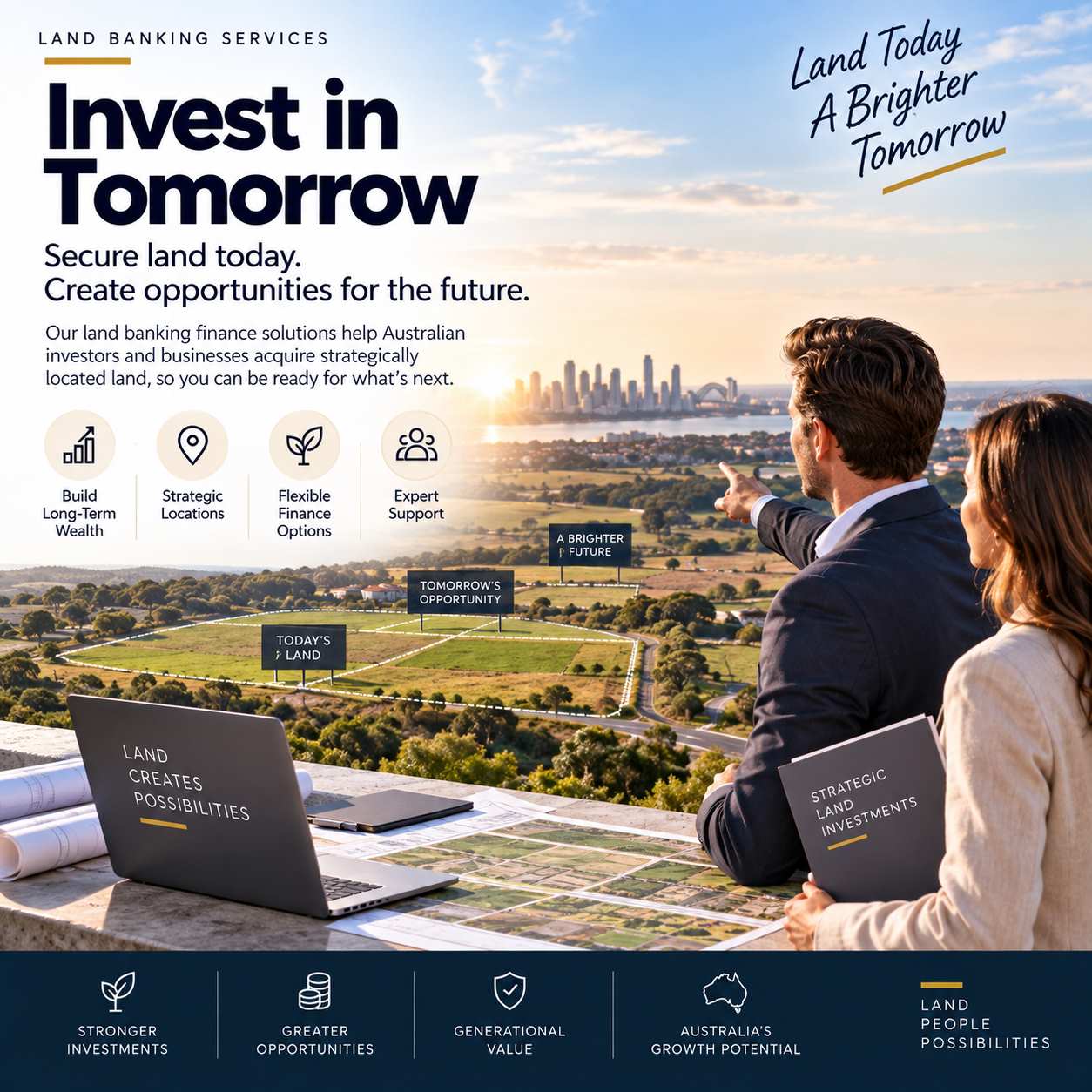
Land Banking: Building Long-Term Value Through Strategic Land Investment
Land is one of the few assets that cannot be manufactured or multiplied. As cities expand, infrastructure develops, and new residential and commercial corridors emerge, strategically located land can become increasingly valuable.
Land banking is a real-estate investment strategy built around acquiring land in areas with potential for future development or appreciation and holding it for the longer term.
For investors, developers, and businesses, the objective is not necessarily to develop the property immediately. Instead, the strategy focuses on identifying land where future growth, infrastructure, zoning changes, or urban expansion may create opportunities over time.
What Is Land Banking?
Land banking involves purchasing or securing rights to land today with the expectation that its strategic value may increase in the future.
A land-banking strategy may consider factors such as:
- Planned infrastructure development
- Expansion of roads, highways, railways, or transit systems
- Growth of residential communities
- Expansion of commercial and industrial areas
- Proximity to employment hubs
- Population and demographic growth
- Changes in land use or zoning
- Availability of utilities and civic infrastructure
- Local development plans and economic activity
The underlying principle is straightforward:
Identify land with strategic potential, secure it at an appropriate valuation, and create an opportunity to benefit from future development.
However, land banking is inherently dependent on location, timing, market conditions, regulations, and due diligence. Future appreciation is not guaranteed.
Why Does Land Banking Matter?
Urban development rarely happens uniformly. Cities and towns generally expand outward along infrastructure corridors, employment centers, transportation networks, and emerging commercial zones.
Land that is relatively peripheral today can become significantly more relevant as development moves toward it.
For example, an area may initially consist primarily of agricultural or undeveloped land. Over time, a new highway, industrial project, educational institution, residential development, or commercial corridor may increase activity in the surrounding region.
This creates a potential transformation:
Undeveloped Area → Infrastructure Growth → Increased Economic Activity → Development Potential
Land banking seeks to identify opportunities earlier in this development cycle.
Land Banking vs. Traditional Real Estate Investment
Traditional real-estate investment often focuses on properties that generate immediate utility or income—such as residential buildings, commercial properties, or rental assets.
Land banking works differently.
The land may generate little or no immediate rental income. The investment thesis is instead based primarily on the property’s strategic location and its potential future use or value.
| Traditional Real Estate | Land Banking |
|---|---|
| Often generates rental income | Usually focused on long-term appreciation |
| Property may already be developed | Land may be undeveloped or underdeveloped |
| Immediate use is common | Future development potential is often central |
| Maintenance may be required | Undeveloped land can have different holding requirements |
| Value depends partly on existing improvements | Location and future development potential can be significant factors |
Neither approach is universally suitable. The right strategy depends on an investor’s objectives, timeframe, liquidity requirements, and risk tolerance.
What Makes Land Strategically Valuable?
Not every piece of land is suitable for land banking.
Location is one of the most important considerations, but it is only one part of the analysis.
1. Infrastructure
New highways, bypasses, rail connectivity, airports, logistics corridors, and public infrastructure can influence future development patterns.
2. Urban Expansion
Growing cities require additional housing, commercial spaces, schools, healthcare facilities, logistics infrastructure, and supporting services.
Land located along potential expansion corridors may therefore attract greater attention.
3. Employment and Economic Growth
Industrial parks, technology hubs, manufacturing facilities, logistics centers, and other employment-generating developments can increase demand for surrounding real estate.
4. Connectivity
Accessibility can influence the usefulness and attractiveness of land. Roads, public transportation, and proximity to important destinations can all play a role.
5. Legal and Regulatory Position
Clear title, appropriate land classification, permitted land use, access rights, and compliance with applicable regulations are critical.
A promising location does not compensate for unresolved legal or regulatory issues.
The Importance of Due Diligence
Land banking requires patience, but patience alone is not enough.
Due diligence is fundamental.
Before acquiring land, investors should investigate matters such as:
- Ownership and title history
- Encumbrances and existing claims
- Land-use classification
- Zoning and development restrictions
- Access and right-of-way
- Survey and boundary records
- Applicable taxes and government dues
- Local development regulations
- Environmental considerations
- Infrastructure plans
- Development approvals, where applicable
Professional legal, property, and financial advice should be obtained where appropriate.
The Role of Financing in Land Banking
Access to appropriate financing can influence the ability to acquire strategically located land.
This is where Tuli Lending can become part of the broader land-investment journey.
Rather than looking at financing as simply a source of funds, borrowers should consider how the financing structure fits their overall investment strategy—including acquisition cost, holding period, repayment obligations, liquidity, and expected use of the property.
At Tuli Lending, our approach is centered around understanding the underlying property and financing requirement so that borrowers can evaluate available funding options with greater clarity.
The right financing structure should support the investment strategy—not work against it.
Land Banking Is a Long-Term Strategy
One of the most important characteristics of land banking is the holding period.
A land-banking opportunity may take years to develop. Infrastructure timelines can change, development plans can be delayed, and market conditions can fluctuate.
Therefore, land banking should generally be considered a long-term strategy, rather than a short-term method of generating returns.
Investors should consider:
- How long they can hold the property
- Whether they need regular income
- Their ability to service financing costs
- Potential transaction and holding costs
- Market liquidity
- Alternative investment opportunities
- Regulatory and development risks
A Disciplined Approach to Land Banking
A thoughtful land-banking strategy can be organized into five stages:
01 — Identify
Study areas experiencing or expected to experience infrastructure and economic development.
02 — Evaluate
Assess location, accessibility, land characteristics, development potential, legal status, and market conditions.
03 — Verify
Complete legal, technical, financial, and regulatory due diligence before committing capital.
04 — Finance
Evaluate the appropriate financing structure based on the property’s characteristics and the borrower’s financial position.
05 — Hold & Monitor
Track infrastructure development, planning changes, market conditions, and potential future uses while maintaining the property appropriately.
The Opportunity—and the Risk
Land banking can offer an opportunity to participate in long-term real-estate growth, but it also carries risks.
Land values can decline. Development plans can be delayed or cancelled. Regulatory conditions can change. Infrastructure may not arrive as anticipated. A property may also be difficult to sell quickly.
Financing introduces additional obligations because repayments may continue regardless of whether the land appreciates.
That is why location analysis, legal due diligence, financial planning, and realistic time horizons are essential.
Land Banking with a Long-Term Perspective
The value of land is often connected to what is happening around it.
A road being planned today may change accessibility tomorrow.
A new employment center may change housing demand.
A growing city may create new development corridors.
A previously peripheral locatio