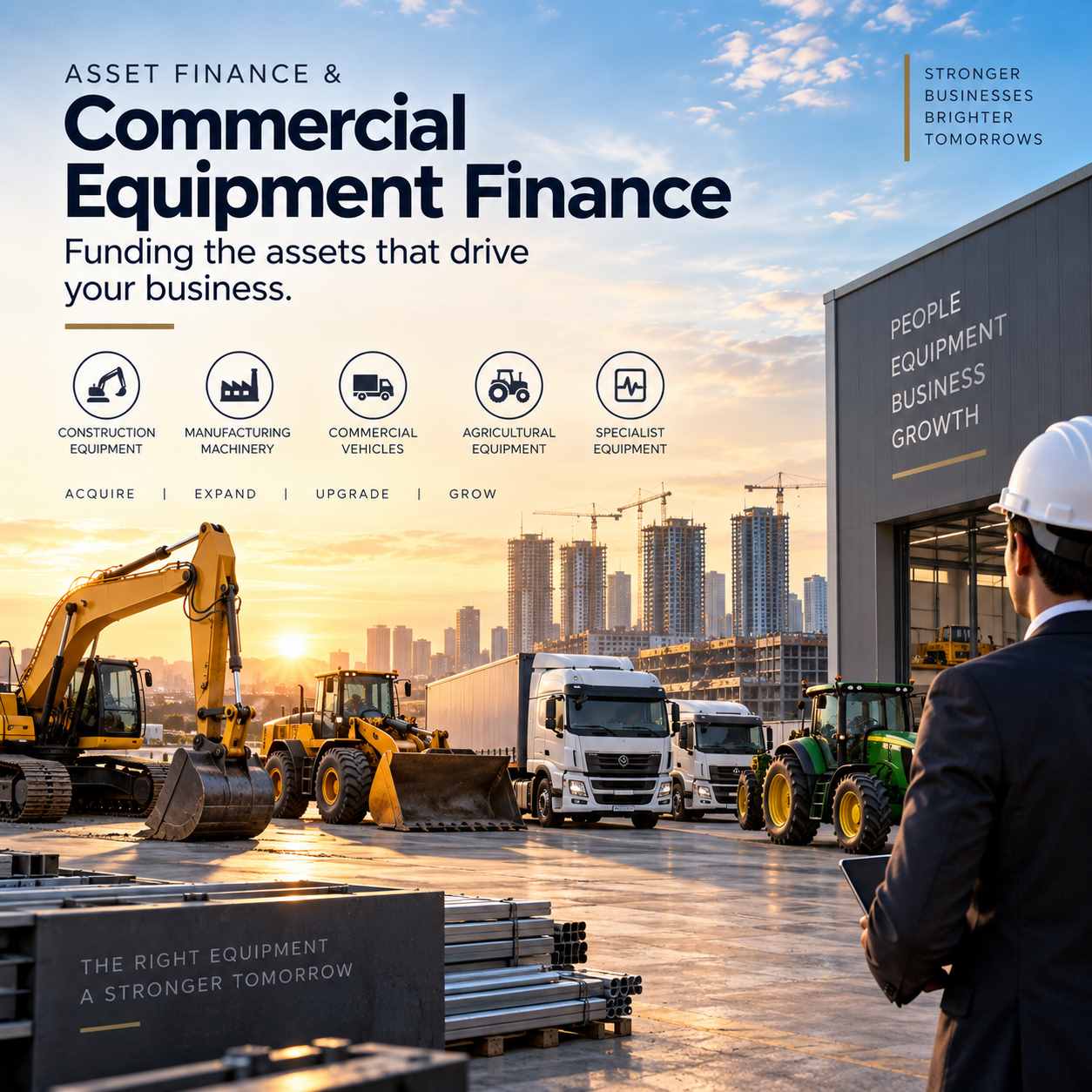
Asset Finance & Commercial Equipment Finance: Funding the Assets That Drive Your Business
Businesses grow when they have the right assets to support that growth.
Whether you are purchasing construction machinery, upgrading manufacturing equipment, expanding a logistics fleet, investing in agricultural machinery, or acquiring specialist commercial equipment, the cost of new assets can represent a significant capital commitment.
Asset finance and commercial equipment finance can help businesses acquire the equipment they need while structuring the cost of that investment over time.
At Tuli Lending, we understand that equipment is more than an expense. It can be an important part of your business’s ability to operate, increase capacity, improve efficiency, and pursue new opportunities.
What Is Asset Finance?
Asset finance is a form of business financing used to acquire, refinance, or access funds against eligible business assets.
Instead of paying the entire purchase price upfront, a business may use a financing structure that spreads the cost over an agreed period, subject to lender terms and eligibility.
Depending on the transaction, financing may be considered for assets such as:
- Construction equipment
- Manufacturing machinery
- Commercial vehicles
- Transportation and logistics equipment
- Agricultural machinery
- Medical and specialist equipment
- Earthmoving equipment
- Industrial equipment
- Technology and business equipment
- Other eligible commercial assets
The specific assets and financing structures available depend on the lender, asset type, borrower profile, valuation, and applicable requirements.
Why Businesses Use Equipment Finance
A major equipment purchase can tie up a substantial amount of business capital.
Using appropriate finance can allow a business to consider acquiring an asset while retaining some working capital for other operational requirements.
For example, a construction company may need a new excavator to undertake additional projects. A logistics business may need additional commercial vehicles to expand its fleet. A manufacturer may require new machinery to increase production capacity.
In each case, the equipment is connected directly to the business’s ability to operate or grow.
The objective is to align the financing of the asset with the broader financial needs of the business.
Commercial Equipment Finance for Business Growth
Equipment is often closely connected to revenue-generating activity.
The right machinery can increase production.
The right vehicle can expand delivery capacity.
The right technology can improve efficiency.
The right specialist equipment can allow a business to take on new types of work.
Commercial equipment finance can therefore form part of a broader growth strategy.
Instead of viewing an equipment purchase only as a capital expense, businesses can evaluate it in terms of:
Capacity → Productivity → Revenue Opportunity → Business Growth
Of course, the financial benefits of an asset depend on the business, the asset, market conditions, utilisation, and the assumptions used in the investment decision.
Asset Finance vs. Using Cash
Businesses often have a choice between paying for equipment from existing cash reserves or financing the acquisition.
Using cash may reduce financing costs, but it can also reduce the liquidity available to manage day-to-day operations and unexpected requirements.
Financing may preserve more working capital, but it creates repayment obligations and financing costs.
The right approach depends on the business’s circumstances.
When evaluating the options, businesses should consider:
- Available cash reserves
- Working-capital requirements
- Expected asset utilisation
- Asset lifespan
- Expected revenue contribution
- Financing costs
- Repayment obligations
- Tax and accounting considerations
- Future capital requirements
Professional accounting and financial advice should be obtained where appropriate.
What Types of Businesses Can Benefit?
Asset and equipment finance can be relevant across many industries.
Construction
Construction businesses frequently depend on heavy machinery and specialist equipment to deliver projects.
Financing may help businesses acquire eligible equipment such as excavators, loaders, cranes, compactors, and other machinery.
Manufacturing
Manufacturers may require machinery to increase production capacity, modernise facilities, or replace ageing equipment.
Financing can potentially help spread the cost of significant equipment investments.
Logistics & Transportation
Fleet expansion can require substantial capital.
Commercial vehicle finance can help eligible businesses acquire vehicles required for transportation, delivery, distribution, and logistics operations.
Agriculture
Modern agricultural operations can depend on specialised machinery and equipment.
Asset finance may support eligible purchases that contribute to productivity and operational capacity.
Healthcare & Specialist Services
Medical, diagnostic, laboratory, and other specialist businesses can require expensive equipment to deliver their services.
Structured equipment financing can form part of the capital planning process for these businesses.
New Equipment or Existing Equipment
Asset finance is not necessarily limited to brand-new equipment.
Depending on the lender and transaction, financing may be available for new or used commercial assets.
The age, condition, market value, specifications, provenance, and intended use of the equipment can all influence financing considerations.
For businesses purchasing used equipment, independent valuation and appropriate due diligence can be particularly important.
Financing Equipment Without Losing Sight of Cash Flow
One of the most important considerations in equipment finance is cash flow.
A business should not evaluate an asset solely on whether it can obtain financing.
It should also ask:
Can the business comfortably manage the repayments?
Before committing to financing, businesses should consider projected cash flows, existing debt obligations, seasonal fluctuations, operating costs, and the expected contribution of the new asset.
The asset should support the business—not create unnecessary financial pressure.
A Practical Approach to Equipment Financing
At Tuli Lending, the financing process begins with understanding the requirement.
01 — Identify the Asset
Determine what equipment or commercial asset the business needs and how it will be used.
02 — Understand the Business
Consider the business’s operations, financial position, trading history, and broader objectives.
03 — Evaluate the Requirement
Assess the purchase price, asset characteristics, financing amount, expected term, and repayment considerations.
04 — Explore Financing Options
Identify financing structures that may be appropriate based on the transaction and applicable lender criteria.
05 — Complete Due Diligence
Documentation, asset information, valuations, financial information, and other requirements may need to be reviewed before approval.
06 — Acquire the Asset
Once financing is approved and the relevant conditions are satisfied, the business can proceed with the acquisition according to the agreed structure.
When Equipment Becomes a Growth Asset
The most important question is not simply:
“Can I finance this equipment?”
A better starting point is:
“What role will this equipment play in my business?”
Will it increase production?
Will it reduce downtime?
Will it allow the business to accept additional contracts?
Will it replace inefficient equipment?
Will it expand service capacity?
Will it support entry into a new market?
Understanding the commercial purpose of the asset helps create a more informed financing decision.
Financing the Tools Behind Your Next Stage of Growth
From a single piece of specialist machinery to a larger fleet or equipment upgrade, capital assets can play an important role in business development.
The challenge is finding a financing approach that considers both the asset and the business behind it.
Tuli Lending helps businesses explore financing solutions for eligible commercial assets and equipment, with a focus on understanding the requirement, the asset, and the broader business objective.
Whether you are replacing essential machinery, expanding your fleet, upgrading equipment, or investing in additional capacity, the right financing structure can form an important part of your capital strategy.
Finance the Asset. Support the Business. Build for What’s Next.
Talk to Tuli Lending about your asset and commercial equipment financing requirements.
Financing is subject to lender assessment, eligibility, asset valuation, documentation, applicable terms and conditions, and regulatory requirements. Approval, rates, terms, and available financing structures may vary by transaction and borrower.